Why More Tasting Notes Do Not Mean More Flavour
Why more tasting notes do not mean more flavour: use a simple tasting routine to describe what you sense without mistaking detail for quality.
A long list of tasting notes can make a food sound impressive without telling you whether you will enjoy it. To judge flavour more clearly, treat each note as a description of a sensation, not a score for quality. A roasted, grassy, citrusy, or buttery impression may help name what you notice; none proves that the food is better.
This distinction matters when comparing coffee, chocolate, olive oil, cheese, fruit, or any food described in elaborate terms. The words can guide attention, but your own preferences, the food’s intended use, and its balance matter more than the length of the description. A short routine across one week can help you listen to your senses before borrowing someone else’s verdict.
Begin the week by separating sensation from judgment
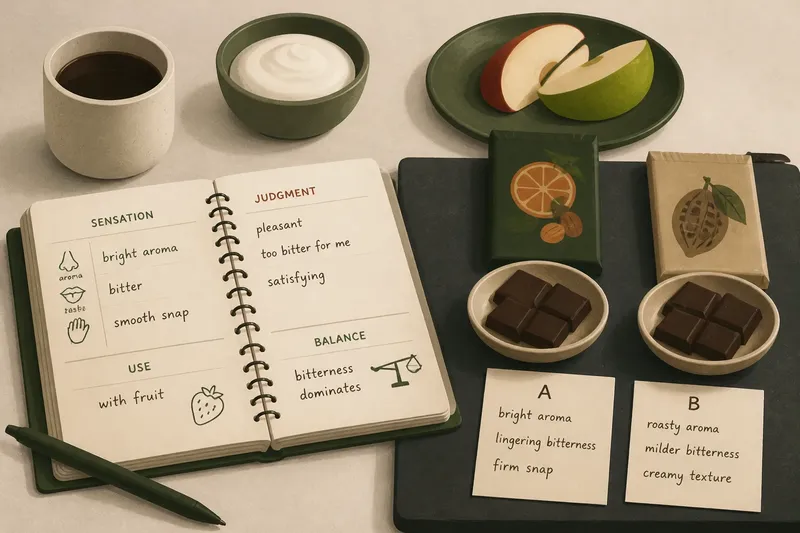
Choose one familiar food you already buy, such as plain yogurt, a piece of dark chocolate, or two apples. Keep the comparison simple: taste one item at a time, without trying to identify every possible note. On the first day, write down what you can directly sense and keep evaluative words in a separate column.
In the sensation column, use words such as sweet, sour, bitter, salty, crisp, soft, dry, creamy, or fragrant. These words describe taste, texture, or aroma in fairly direct terms. In the judgment column, record your reaction: pleasant, too sharp for me, satisfying, or not something I would choose again. “Too sharp for me” says something about fit and preference; it does not establish a defect.
Aroma and taste often get blended in everyday speech. A coffee drinker may call a cup fruity because its aroma brings to mind berries, while the basic tastes are mostly bitter and sour. You do not need to resolve the terminology perfectly. Just note whether an impression came from smell, taste, or texture when you can tell.
Use the second day to notice how language directs attention
On the next day, read a product description before tasting your chosen food. Then taste it once while keeping the description in mind, and once without looking at the words. Notice whether a suggested note becomes easier to detect, whether you genuinely sense it, or whether the wording changes only your expectation.
This is not a test of whether the description is true or false. Flavor is shaped by attention, memory, and context as well as by the food itself. A smell that reminds one person of a garden may suggest fresh herbs to someone else. The useful question is not “Did I identify the official note?” but “Does this word help me describe my own experience?”
For example, say you buy a bar whose wrapper mentions orange peel and toasted nuts. You taste it and notice a bright aroma, a lingering bitterness, and a firm snap, but no clear nut flavor. You can record those sensations and decide whether you like the balance; there is no need to force the wrapper’s language into your own account.
Make the middle of the week about useful comparison
On the third or fourth day, compare two versions of the same kind of food in a way that resembles a real choice you might make. You could compare two coffees prepared the same way, two plain yogurts, or two cheeses you might put on the same sandwich. Keep other conditions as similar as is practical: use the same cup or plate, taste them at a similar temperature, and avoid adding different toppings.
Write a few observations for each item, then ask which differences would matter in your life. A more aromatic coffee may be enjoyable on its own but not work as well with milk. A tangier yogurt may suit fruit while a milder one may better fit a savory sauce. Those are useful distinctions because they connect sensory description to a purpose.
Do not treat the comparison as a contest that needs a universal winner. One item may have a longer finish, meaning its taste lingers after swallowing, while the other may feel smoother or more balanced to you. A tasting note can identify a quality you value, but the verdict depends on what you want from the food.
Use a short vocabulary instead of chasing every note
By the middle of the week, try writing no more than three sensory observations for each food. This limit is not a rule for everyone; it is a way to avoid turning tasting into a hunt for increasingly obscure words. Pick the observations that help distinguish the food from its comparison or explain your response.
A practical set of prompts can keep notes clear:
- Aroma: What do you smell before tasting, in ordinary language?
- Taste: Which basic tastes stand out, such as sweetness, sourness, bitterness, or saltiness?
- Texture: Is the food crisp, grainy, silky, chewy, or something else?
- Balance: Do any sensations seem to dominate, and do you enjoy that?
- Use: Would you eat it on its own, pair it with something, or use it in a particular dish?
Specific language helps most when it makes a distinction you can act on. “Strong” can mean intense aroma, pronounced bitterness, or simply a flavor you do not prefer. Replacing it with a more exact observation gives you a better basis for choosing, without pretending that precision makes the food objectively superior.
Review your notes near the end of the week
On the sixth or seventh day, look back at what you wrote and mark the words that helped you make a choice. You might discover that “crisp” mattered for apples, while “long finish” did not affect whether you wanted more chocolate. That is not a failure to appreciate flavor. It is information about which qualities are useful to you.
Then write one sentence that combines description with preference: “This cheese is salty, crumbly, and pleasantly sharp for crackers,” or “This coffee smells floral, tastes bitter to me, and works better with milk.” The sentence gives a reader a clearer picture than a string of disconnected notes, because it shows which observations led to your judgment and where that judgment applies.
Keep an eye on the difference between a sensory description and a quality claim. “I taste a grassy note” reports an impression. “This is a superior oil” makes a broader judgment that needs a standard: superior for freshness, for a particular dish, or for a person who likes that style? Without such a standard, richer wording can sound authoritative while leaving the actual basis of the verdict unclear.
Which tasting notes help you choose?
Are tasting notes objective facts?
Some terms point to readily recognizable sensations, but many flavor descriptions depend on personal memory and attention. Treat a note as someone’s attempt to communicate an impression, then decide whether it matches what you sense.
Does a longer flavor description mean better food?
No. More words may reflect a writer’s vocabulary, the tasting context, or the wish to describe several sensations. Quality depends on the food and the standard being used, while enjoyment also depends on your preferences and intended use.
How can I compare foods without expert language?
Taste comparable items under similar conditions and describe aroma, basic tastes, texture, and balance in familiar words. Finish by naming the use or preference that matters to you, such as which one suits breakfast or a sauce.
What should I do when I cannot detect a listed note?
Leave it out of your own description rather than searching until you think you have found it. You can still use the other information you noticed to decide whether the food suits you.
Keep the routine focused on your own decisions
Repeat this weeklong routine only when a comparison is useful, not for every item you eat. A few grounded notes can help you choose between products, explain why one works in a dish, or remember what you would buy again. More tasting notes do not mean more flavour, and a more elaborate description does not settle the question of quality.
The most useful tasting vocabulary is the vocabulary that changes a decision for the better: a word that helps you recognize a texture you enjoy, avoid a balance you dislike, or choose the right food for a particular meal. Keep those words, and let the rest remain someone else’s description.